The Milestone Map: Your On-Ramp to the Solution
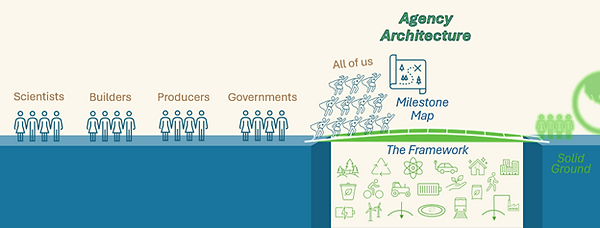
The Framework tells us what needs to happen. The Five Gaps tell us why the system has been working against us. The Milestone Map tells us who does what, and in what order. Think of it as the walkway across the bridge - with a lane for every traveller.
A solution set that just sits there isn't a solution. It's a blueprint. What turns a blueprint into a built thing is people using the blueprint and acting in the right sequence, in their own roles, with enough shared understanding to move together.
That's what this map is for.
There are five actor groups. All five help build the Agency Architecture. Each group’s actions have three phases: See (understand your role and the system), Build (take the foundational actions in your lane), and Move (scale, advocate, and connect your actions to the whole). You don't need to complete one phase before starting the next. And you don't need to do everything. The map just makes it easier to see where you might fit in. And how even small actions - connected to the right system - matter.
1. Governments
The rule-setters. The ramp-designers. The only actors who can close the geographic gap and make the price tell the truth across the whole economy.
See
-
Understand that the costs of climate inaction are already being paid - through insurance markets, disaster relief, taxpayer-funded backstops, increasing security risks, and long-run GDP erosion. The question is not whether to pay, but through which channel and with what incentive effect.
-
Understand the Five Gaps and which ones only government can close: the payment displacement gap (ramp the decarbonization requirement for all emissions), the geographic displacement gap (CBAMs), and the accounting opacity gap (mandatory disclosure standards).
-
Understand that the public supermajority already supports action - and that the political risk of acting is lower than it appears. The silence of the majority is not indifference; it's a gap between private belief and visible participation that policy can help close.
-
Understand Geological Net Zero ("Geo Zero") as the physically-correct target and the standard that rules out greenwashing by definition.
Build
-
Require climate footprint labels on consumer goods and services. This is the single most direct way to close the missing signal gap - the structural disconnect between what we buy and its climate consequence. When consumers can see the footprint of what they're choosing, they can act on it. When producers know their footprint is visible, they compete on reducing it. A label doesn't tell anyone what to choose. It just makes the honest information available - the way a nutrition label changed how we understood food. Start with the highest-impact categories: food, transport, home energy, electronics. Methodology doesn't need to be perfect on day one - it needs to be mandatory and improving. This is a first-mover opportunity: the country that sets the standard others follow earns reputational, economic, and diplomatic advantages.
-
Open all abatement pathway regulations - the science-aligned "do our best and remove the rest" pathways - including permanent carbon dioxide removal (CDR). Expedite standards and remove regulatory barriers to deployment.
-
Set the decarbonization ramp. Mandate that every emission in every sector account for and ultimately eliminate its emissions footprint, starting modestly where necessary and rising predictably to 100% by 2045–2050. This is honest accounting applied consistently. Producers will decarbonize their supply chains first - in almost every case that's less expensive than removing residual emissions - and permanent CDR backstops whatever remains. As the requirement rises, solution costs fall. That's the market working as it should.
-
Implement Carbon Border Adjustment Mechanisms to prevent imports from countries without equivalent pricing from undercutting domestic producers who are playing by the rules. This closes the geographic displacement gap - ensuring that responsible action at home isn't undermined by unpriced emissions crossing the border.
-
Fund and standardize emissions accounting infrastructure so that footprint calculations are verifiable, comparable, and fraud-resistant.
-
Establish two distinct funding streams: one for Geo Zero - emissions reduction and permanent removal - and one for ecosystem protection and restoration. Nature-based solutions were distorted by being asked to serve as permanent carbon storage - a job they were never designed for. Funding them separately, accountable to the full range of Planetary Boundaries they actually serve, corrects that distortion and makes the case for nature on its own terms.
Move
-
Connect climate policy to public wellbeing framing. Climate anxiety in young people is a recognized and growing public health issue. Policy that restores agency and provides a visible pathway is mental health policy as much as environmental policy.
-
Engage with the Agency Architecture as a complete system. The gaps that remain open will continue to bleed costs inefficiently through insurance, disaster relief, security, and adaptation budgets.
-
Collaborate internationally on accounting standards and CBAMs. The geographic gap cannot be closed by any single country alone.
-
Report transparently on progress against the ramp - making the trajectory visible builds the public trust that sustains political will over the decades the transition requires.
2. Producers
Companies, manufacturers, supply chains - the people who embed emissions in the products we buy, and who will innovate faster than anyone once the price signal is clear.
See
-
Understand that your emissions footprint is already being priced - just through your customers' insurance premiums, their taxes, and the growing cost of climate-related disruption to your own supply chains. Honest pricing at the product level is not a new cost. It's a redirected one.
-
Understand that in almost every sector, supply chain decarbonization is less expensive than permanent removal - which means early movers on abatement will win the cost competition as the decarbonization ramp rises.
-
Understand that consumers want to know, and that competitive pressure on footprint is coming whether or not mandatory labelling arrives first. The race to the bottom on emissions will eventually become a race to the top. Better to be ahead of it.
-
Understand Geological Net Zero as the destination - every tonne you release from geological storage must eventually return to permanent storage. Plan your product roadmap with that endpoint visible.
Build
-
Measure and publish your product carbon footprints - even before it's mandatory. Methodology is improving rapidly; being in the game now builds the competency that will be required later.
-
Engage with the supply chain. Scope 3 emissions - the ones embedded in what you buy and what goes into making your product - are where most of the footprint lives and where most of the abatement opportunity lies. Your job is to get that footprint to zero.
-
Develop at least one Geo Zero product - a product whose residual emissions, after maximum abatement, are permanently removed through verified CDR. This is the proof-of-concept that shows the market what's possible and builds the customer trust that scales.
-
Participate in industry coalitions developing footprint accounting standards. The methodology gets better faster when producers engage in building it rather than waiting for regulators to impose it.
Move
-
Make footprint labelling a competitive advantage, not a compliance exercise. The producer who makes their footprint visible and low - and who can explain why - earns trust that advertising cannot buy.
-
Advocate for the ramp - yes, advocate for the policy that will require you to decarbonize. A predictable, gradual mandate is better for long-term planning than the uncertainty of inaction followed by a sudden regulatory cliff. Work with governments to design a ramp that gives you time to adapt.
-
Offer Geo Zero products at accessible price points. The 2% premium is a feature, not a flaw - but only if consumers can see what they're getting and trust the accounting behind it. Make the transparency part of the product story.
-
Report progress publicly and honestly. Producers who lead on transparency set the standard that pulls others forward.
3. Builders & Innovators
The entrepreneurs, technology developers, engineers, operators, project developers, investors, and lenders deploying solutions at speed and scale. Their job is to drive costs down the learning curve faster than the ramp rises.
See
-
Understand the Marginal Abatement Cost Curve - the ranked list of every available solution from cheapest to most expensive. Know where your technology sits on it and how your cost trajectory fits in the ramp.
-
Understand that the hard-to-abate 10–15% - aviation, shipping, cement, some industrial processes - cannot be solved by electrification alone. CDR is not a fringe technology; it is a necessary component of the complete solution set, and the demand for it is large and growing.
-
Understand the Planetary Boundaries Test: solutions must not solve one boundary problem by breaking another. Water, land, biodiversity, and nitrogen all count. Design with the whole system in mind from the start.
-
Understand the accounting gap - measurement infrastructure is a critical enabling layer. Technologies that come with credible, verifiable accounting methodologies will scale faster than those that don't.
Build
-
Deploy what already works - solar, wind, heat pumps, EVs, building efficiency, grid storage. The learning curve only moves when deployment happens. Every project counts.
-
Engage CDR capacity now, even while costs are high. The cost curve for permanent removal will follow the same pattern as solar and EVs, and it is already competitive for hard-to-abate sectors.
-
Develop and publish credible, verifiable measurement methodologies for your technology's footprint and removal claims. Rigorous accounting is not a bureaucratic burden - it's the trust infrastructure that the whole market needs.
-
Partner with producers to develop Geo Zero products. A committed producer willing to pay for verified removal is one of the most reliable funding sources an innovator can find.
Move
-
Drive costs down. The goal is for abatement and removal to be less expensive than the rising mandate where we can, and minimally more expensive where we will have to incur an extra cost.
-
Engage with standards bodies and government on methodology. The accounting infrastructure needs builders at the table, not just regulators.
-
Make your work visible - to the public, to policymakers, to young people who need to see that the technology exists and is real. Public confidence in climate solutions is partly built on visible proof that the technology works.
-
Connect across the solution set. CDR developers, electrification deployers, efficiency innovators, and measurement specialists are not competitors - they are complementary layers of the same system.
4. Scientists
The boundary-keepers. The feasibility-provers. The standard-setters. They have produced the science the entire Architecture rests on - and watched it disappear into broken feedback loops, year after year, with precision and without traction.
The Agency Architecture doesn't ask scientists to do something different. It offers something different: a system designed to finally receive what they've already been sending - and create the pull that turns published science into market signal and policy action.
See
-
Recognize that the reason the science hasn't moved the system fast enough is not a failure of the science, or of scientists. The Five Gaps structurally prevent signals from reaching decision-makers and consumers in actionable form - even when the evidence is overwhelming and the communication is excellent. Sound science has been shouting into broken feedback loops, not into indifference. That distinction matters.
-
Recognize that the voluntary carbon market's credibility failures have landed on the whole field - including the permanent removal technologies doing exactly what the science requires. This is a category error with real policy consequences, and correcting it publicly is a high-leverage contribution right now.
-
See where your existing work already slots into the Architecture - and where the Architecture creates new demand for what that work knows. The Planetary Boundaries framework is the diagnostic foundation of the whole system. The Geological Net Zero standard is the physically-precise target that rules out greenwashing by definition. The MACC is the feasibility proof that makes the ramp politically legible. Scientists built all of this. The Architecture is, in large part, applied science waiting to be connected.
-
Notice what's new here: not a request to communicate more or differently, but a complete system that's designed to aggregate and amplify the signal this work has already been sending - and close the gaps that have been absorbing it. What did we miss? How can we make it better?
Build
-
Measurement and methodology work - on Scope 3 accounting, CDR verification, and permanence standards - is the trust infrastructure the entire market depends on. Where those methodologies are weakest is where greenwashing is most likely and where the ramp is most vulnerable. The places that are hardest to measure are the places the system most needs you.
-
The Planetary Boundaries framework is already doing foundational work in the Architecture - it's the diagnostic that makes the whole system legible. Keeping it current and accessible isn't maintenance; it's load-bearing.
-
Where the distinction between rigorous permanent removal and discredited temporary offsets has already been drawn, that work has immediate policy consequence - even if it hasn't felt that way. The Architecture gives it a system to land in.
-
Partnering with producers on Geo Zero product development is one of the most direct paths from scientific knowledge to market signal. The demand for credible methodology from committed producers is real and growing.
-
Carbon markets have long treated nature-based solutions and permanent geological storage as interchangeable - one pot of money for two very different jobs. That category confusion is one of the most consequential open questions in climate finance - and it needs scientists at the table to resolve it. Nature-based solutions were asked to serve as permanent disposal infrastructure for fossil carbon; they were never the right tool for that job, and the incentive structure reflected that mismatch. The answer isn't to defund nature - it's to fund it correctly, through a separate stream accountable to the full range of planetary boundaries it actually serves, including biodiversity, freshwater, soil, temporary carbon storage. The scientific work needed is real and not fully solved: how do we honestly quantify the climate value of temporary biological storage? How do we design accountability frameworks for "tree" projects that measure what trees are actually for? That methodology doesn't exist at the scale and rigour the market needs. This is an open invitation.
Move
-
The science exists. The Architecture now gives us a complete system to point to - not just the problem and the urgency, but the mechanism, the gaps, and the pathway. That changes what's possible in a policy conversation or a public talk.
-
The 3.5% visibility threshold applies to scientists too - not just citizens. When researchers speak publicly about feasibility, not just risk, they shift what politicians believe is scientifically defensible to act on. That's a different kind of contribution than a journal article, and it matters just as much right now.
-
Cross-boundary collaboration - climate scientists, biodiversity scientists, hydrologists, soil scientists - is where the Planetary Boundaries framework gets most powerful. The Architecture needs integrated knowledge, not siloed disciplines, to hold the Planetary Boundaries Test against proposed solutions.
The signal was always there. Now there's a system designed to receive it.
5. The Rest of Us
Citizens, consumers, community members - the demand side, the voters, the social proof. The most powerful force in the system when visible.
See
-
Read The Framework. Understand the big picture and the roles that everyone plays.
-
Explore the Five Gaps - understand why individual action alone hasn't been enough, and why it matters now more than ever when connected to the system.
-
Understand that climate anxiety and grief are real, clinically recognized, and growing. The despair is rational in its origin: the problem is real, the stakes are real, and for a long time the path forward wasn't visible. But hopelessness is not warranted. The tools exist. The pathway is clear. What dissolves despair isn't managing it - it's seeing the complete picture, having real tools, and connecting to a community of people already acting. Agency is the antidote.
-
Understand that 81% of global emissions serve personal consumption - which means the solution has to include the consumer side. That's not a burden, it's leverage.
-
Check the climate footprint in one area of your life (e.g., food, transport, home energy). Not to feel guilty - to get oriented.
-
Understand Geological Net Zero: the difference between "carbon neutral" on a label and the real thing. Why we need to "do our best" to reduce emissions and then permanently "remove the rest" on geological timescales.
-
Understand that climate is one of nine Planetary Boundaries — and that solutions which fix one climate boundary by breaking others (e.g., land, biodiversity, freshwater, soil) are not solutions. The race to Geo Zero must not come at the expense of the biosphere that sustains us.
Build
-
Log your actions in the Planetary Action Atlas. Even once. This is one of the ways to make the supermajority visible. It takes 60 seconds and not only does your country get counted, it can bring hope to someone across the world.
-
Pick one area from the Atlas and implement one idea this week. Start where the money and the carbon savings overlap - we're building resources in Cut Costs, Cut Carbon.
-
Use the Eight Rs as a daily lens: Refuse, Reduce, Reuse, Repurpose, Repair, Rot/Compost, Recycle, Remove. You don't need to master all eight. Pick two.
-
When you see a product with a climate footprint label, pay attention to it. When you don't see one, notice that too. Your attention is a vote.
-
Tell one person about something you're doing. Not to lecture - just to be visible. That's the 3.5% mechanism - the "How a small minority can change the world" - in action.
Move
-
Write to your representative asking for all four Advocacy Ideas. Use the combined template on the Advocacy page - one letter that asks for footprint labels, open abatement pathways, Geo Zero product standards, and a clear ramp for all emissions. Five minutes. One email. A representative who hears from ten constituents on the same issue treats it as a movement. If you only do one thing on this page, make it this.
-
Write to a company asking about their product's footprint. Use the Geo Zero Products template. Nothing tells a producer more directly what matters than hearing from their customers.
-
Don't forget the biosphere in the race to Geo Zero. Advocate for two separate pots of public funding: one for Geo Zero ("do our best" and permanently "remove the rest"), and another for ecosystem protection and restoration - the forests, wetlands, soils, and biodiversity that are critical to so many planetary boundaries.
-
Keep adding your actions to the Atlas - once a day or once a week. Each entry is a ballot in the silent referendum.
-
Visit your representative in person. Bring a friend. Mention that climate footprint labels are a first-mover opportunity for your country - not a burden, a competitive advantage. Mention that as a taxpayer, you want your country to take smart steps to get to zero.
-
Share Advocacy Ideas in conversations, community groups, and social media. Share The Framework or the Atlas with someone who needs a bit of hope.
-
Invite one person to join the A Team. The supermajority becomes visible one person at a time.
Reading the Map Together
A few things to notice about how the groups connect:
The Rest of Us make it clear - through visible choices and letters and votes - that there's both market demand and political permission to move.
Producers respond to three things at once: consumer demand through footprint competition, government requirements through the ramp, and falling solution costs from builders. When all three line up, producers move fast.
Governments close the gaps that markets can't close alone - the geographic gap, the payment gap, the accounting gap. Without government action, the broken connections between cause and consequence stay broken, regardless of how much individual action happens. Builders drive costs down, making compliance cost only 2% more for most products. Without them, the ramp is painful. With them, it's manageable.
Scientists keep everything honest - the boundaries, the accounting, the feasibility proof. Without them, every other lane is navigating by guesswork.
No group is more important than another. No actor can do another's job. The milestone map isn't a hierarchy - it's a system. And like all systems, it works when every part does its part.
All of Us cross the bridge together – reaching Solid Ground and providing a sustainable world to future generations – where what we take, make, and waste stays in harmony with what the earth can replenish, restore, and renew.
The Agency Architecture = The Framework + The Five Gaps + this Milestone Map. The bridge exists. Now you know your on-ramp.
Explore the other parts of the Agency Architecture
Go back to the Framework or the Five Air Gaps:
→ The Framework: How We Actually Solve This
→ The Five Gaps: Why Climate Solutions Keep Underperforming
Explore all three reports together:
→ Return to Agency Architecture